
Recoleta

Every Thursday. In the afternoon. The same walk from the house to the station. The same train into the heart of the city. The same blocks from the station to the cemetery. And once there, the same work. It is now her only ritual.
After two and a half years she has the stations memorized. San Isidro, where she lives in their house, then Acasusso, Martínez, La Lucila, Olivos, Vicente López, Rivadavia, Núñez, Belgrano, Lisandro de la Torre, and finally, Retiro. She prefers the 1:02 train that departs after she prepares lunch for the ladies and that arrives downtown at 1:29. She always has a seat on the trip to see him but often has to stand for the return, when the people who work in the city fill the trains on their way home to the suburbs that sprawl along the river to the north and west.
The routine of Mirta’s weekly afternoon away from the house varies only slightly. The clothes she wears, always simple, change for the seasons. In summer she wears plastic sandals and a cotton dress of a small print fabric with narrow squared straps and a skirt that falls just above her knees. Spring and fall she wears black shoes with rubber soles and covers her shoulders with a navy sweater. In winter she wears a heavy cloth coat, a scarf, gloves and thick hose under her long-sleeved dress. Mrs. de Alba insists that she wear a dress every day. Like so many other aspects of her life, Mirta has grown accustomed to what is expected of her and never considers dressing in any other way. After years of assertion, the desires of the de Albas have become her own.
With her bag in the seat next to her, she stares out the window, oblivious to the few others on the train. Every so often she pats the pocket over her right thigh to confirm that the key is still secure. She kept it on a crimson ribbon around her neck until the metal began to tarnish and leave a green stain on the skin between her breasts.
She checks the sign in each station to note her progress and, as the train nears the final stop, leans her head against the glass and watches as the station sucks the silver tube of the train into its mouth. She steps onto the platform and is caught up in the spawn of people making their way into the wider spaces of the station and then out into the city.
Despite the heat and humidity of this summer day, she prefers it to the damp cold of winter. She likes the attention the fit of her summer dress attracts in the station. It fits her so perfectly that after all the years of wear she thinks that it somehow knows the contour of her body, knows how to keep its distance from actual contact with her skin, to hover just beyond her body, as if to say I know you, every inch of you.
As she walks through the station she knows the wealthy men in the wood-paneled bar follow her with their eyes and that the men selling bread and newspapers from kiosks on the sidewalk outside grin at each other when she walks by. She is certain they exchange comments when she is out of sight but she does not acknowledge their stares. She is proud that at forty-one her body can still command such attention. Her black hair, cut to just above her shoulders, is beginning to gray but her taut body has retained the same compact shape for over twenty years.
She turns to the right outside the station, checks the time on the tall brick tower in the opposite square, crosses the wide avenue that runs beside the station and begins the slow trek up the long hill to the cemetery. With each step she becomes more self-conscious. She is more aware of her hair, dress, the way she walks, the color of her skin. She knows that the eyes that follow her here are not admiring her body. Here they wonder which family she works for, what she is doing walking down their street on a Thursday afternoon, what errand she is on in this neighborhood.
She reaches the top of the hill as her hands tire of carrying her bag, her legs tighten, and perspiration forms on her upper lip, under her arms, and at the back of her neck. She pauses to rest at the bus stop across the street from the Basilica de Nuestra Señora del Socorro and finds comfort in the words painted in black beside the entrance to the sanctuary. She reads them over and over as she rests, moving her lips to form the words. Es Padre y Nos Perdona. Es Padre y Nos Perdona. Es Padre y Nos Perdona.
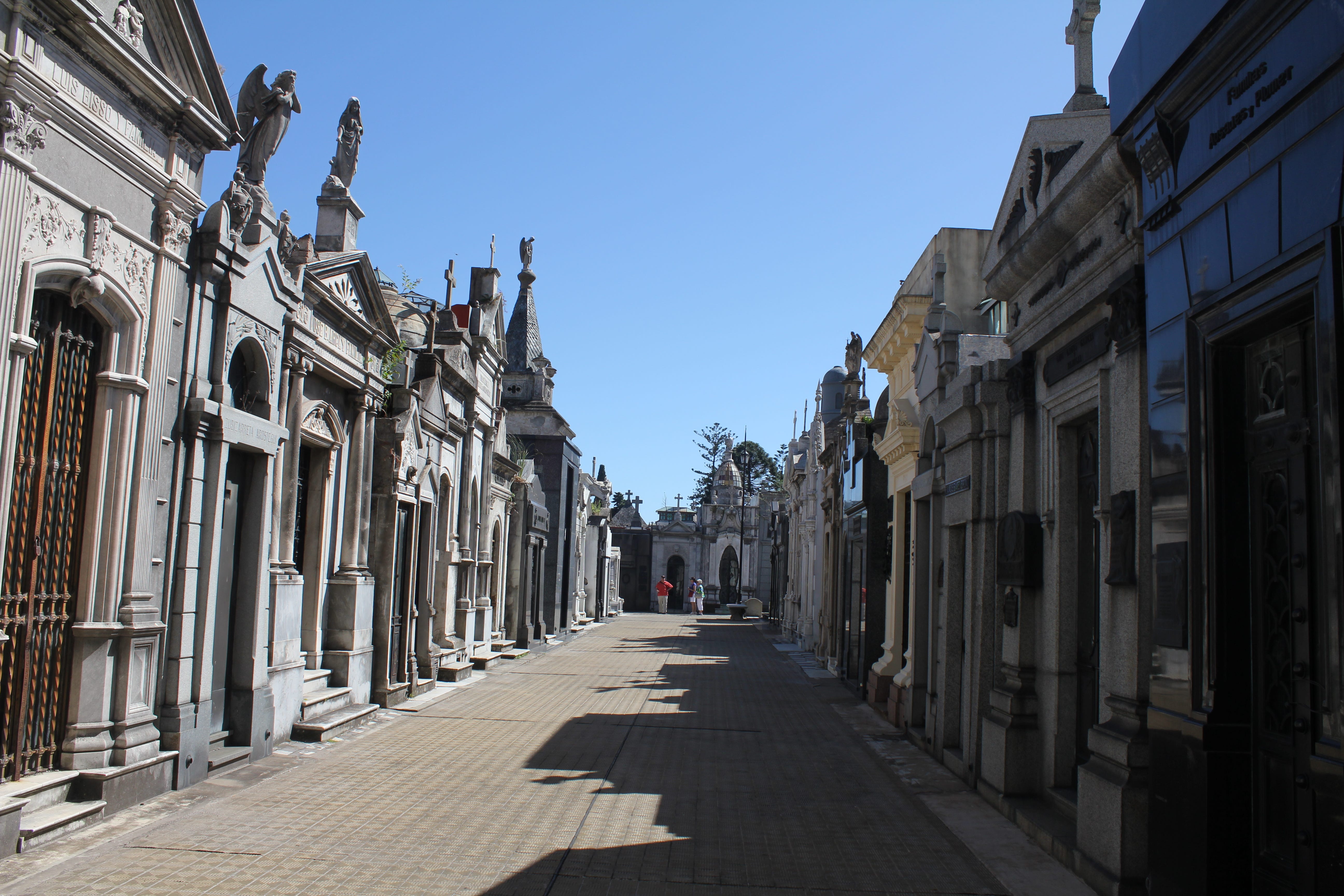
She feels the crunch of the grit from her shoes on the polished stone when she walks beneath the entrance of the cemetery. After exchanging a nod with the guard at the gate and stooping to pet two of the many cats that live within the walls, she walks down the broad cedar-lined avenue, ignoring the clumps of tourists wandering among the tombs. She makes a series of left and right turns, then stops in front of the de Alba crypt.
The crypt is twenty-five feet tall at its peak, the exterior walls made of smooth gray granite with two wide glass doors centered in the front with black iron bars across them. Two small windows, just above the top of Mirta’s head, flank the doors. A wrought-iron skylight of opaque glass caps the roof and the family name is carved inside the stone triangle that forms the uppermost part of the building’s façade.
Mrs. de Alba told Mirta on the day of Mr. de Alba’s funeral that his grandfather had designed the crypt and that the façade and doors were small replicas of those from the building on Florida Street that housed the business his grandfather founded when the family first emigrated from Spain.
She pulls the flat brass key from her dress pocket and slowly inserts it into the lock. She feels the clicks in the bones of her hand as the key lifts the tiny drums inside allowing the bolt to yield.
She pauses to inhale the smell of the rush of air from inside. It reminds her of the first spray from the hose when she rinses their patio on a hot summer day. She steps inside, bends and releases the lower bolt of the other door from its place in the marble floor, then stands on point to reach the upper latch. She swings both doors out and fully open.
* * *
Two weeks after her sixteenth birthday, eyes still burning from her own mother’s death, Mirta faced a decision. The street, the convent, or the house of a rich family. To Mirta they all meant servitude.
She stood at the back door with her suitcase at her feet. When she knocked as instructed, Mrs. de Alba, with a telephone to her ear, pulled the door open with her toe, stretching the phone cord across the wide kitchen to let her in. Without interrupting her phone conversation Mrs. de Alba gestured with her head for Mirta to wait in the small room off the kitchen. She carried her battered suitcase into the room, put it down at the foot of the small iron bed, and sat until Mrs. de Alba came in to tell her what to do next. The room was bare save for the bed, a night table, a dresser, and a mirror. A small crucifix hung over the head of the bed.
* * *
From the door to its back wall the crypt measures less than two full steps. The room is only slightly wider than the length of his coffin. The upper halves of the walls are made from a white stone, the lower parts of a dark gray marble. The steps and floor are an even darker shade. The inside surfaces, all highly polished, reflect the sunlight and create the impression that provokes tourists, who look in through the glass doors during their tours, to comment on the inviting atmosphere within the small space. There are three marble shelves on the wall opposite the door; the uppermost a small alter and the two beneath it for coffins. The windows above the top shelf are of yellow and green stained glass. Under the two windows on the right hand wall are a narrow set of stairs that lead to the crypt below ground. Mirta does not know if she is supposed to dust or clean the room down there. No one ever mentioned it to her, as they never mentioned those stored below.
She has never been down the steps but imagines more shelves and coffins or urns with ashes, at least those of his parents and perhaps aunts and uncles, are there. She always polishes the brass railing that runs along the edge of the steps but decided on her first day to clean only the first three steps. She knows that is as far as the light penetrates.
She knows that someday, perhaps after Mrs. de Alba joins him, or when his own son dies, that he will be moved to the space below to make room for the next generation. She likes that the grit from her shoes and the dust stirred by her cleaning drift down to rest on the coffins of his ancestors.
* * *
She met him on the first morning she was in their house. The two de Alba men, father and son, similarly dressed and carrying briefcases, came into the kitchen. Running in from another part of the house, Mrs. de Alba shouted for them to wait. She wanted them to meet the new girl. The elder Mr. de Alba, looking back over his shoulder as he walked out the door, exchanged with Mirta a sympathetic glance. She saw in his eyes that very day that he wanted her. He was old enough at the time to be her grandfather. His son was ten years her senior.
* * *
Her cleaning supplies rest in the corner of the crypt to the left of the doors. Neatly arranged they cannot be seen from outside: a plastic bucket, faded blue with a red handle, in which stands a broom and mop, a long-handled ostrich feather duster, a spray bottle of green window cleaner, a tin of brass polish, a small box of soap powder, an assortment of rags, and a single roll of paper towels.
She removes an apron from her bag, puts it on, then moves the supplies out onto the walkway in front of the crypt. She returns inside and begins with the feathered duster. Reaching up, she dusts the frame of the skylight then slowly turns in place to trace the shape of the stone ceiling. She then follows the line where the ceiling meets the stones of the wall, slowly turning counter clockwise as she lowers the duster a bit each turn. She is able to dust the upper half of the crypt by standing in one place, extending her arm and shuffling and spinning on the balls of her feet. As her extended arm becomes parallel to the floor and the ostrich feathers begin to brush the top of the cross on the alter shelf, she stops spinning and dusts the rest of the crypt down to the floor.
* * *
Less than a year after she arrived to live in their house, without saying a word, she let him know that it was time. Mrs. de Alba, her son and daughter-in-law were at Holy Mass. Mirta was at the sink washing the Sunday breakfast dishes and Mr. de Alba walked into the kitchen from his study. Mirta dried her hands, turned, nodded her head slightly and walked into her room. Mr. de Alba followed.
After that they were together every Sunday. His wife always told the priest that Mr. de Alba wasn’t feeling well or that she couldn’t get him away from his stamps. Mirta always went to mass very early, before she bought the medialunas, juiced the oranges, and brewed the coffee for the family’s Sunday breakfast. Before this Mirta spent her Sunday afternoons wandering in the city or visiting her few friends from childhood. But slowly her connections had dropped away.
He told her once, when they were finished, while his thick hand rested on her stomach, and raised and lowered with her every breath, that he saw something in her that no one else could see. He said that he saw potential just beneath her skin, like a bow drawn back or the tight-wound spring of a clock.
* * *
She takes the cross, two candlesticks, a small potted plant, and a brass matchbox from the shelf above his coffin and places them on the top step just outside the door. She then sits next to the alter pieces with her feet on the concrete walkway and dusts the plant and polishes the other items. When this is done she walks to the nearby spigot and retrieves a bucket of water.
She learned this method of cleaning from her mother: dust, then sweep, start from the highest and most distant part of the room, work down and out toward the exit. After this first removal of dry, unattached dirt and dust came any polishing, including metal or wood, then came wet cleaning of windows and flat surfaces, another quick sweep, followed by the final step of mopping. The room was left in a perfect state and any mess created by an earlier step in the process was removed in the subsequent part of the work. This was the extent of her mother’s legacy.
She first touched him a month after the funeral. Until then she assumed the coffin was well-sealed. As she stood from bending to pick up a string that had come loose from her mop, her elbow caught the edge of his coffin’s lid. She felt it lift then heard the chuff as it fell back into place. She turned and saw that a bit of the mantilla was now caught between the lid and lip of the coffin. Since then, every week, she touches him. She wants to see him, but the marble shelf above the one on which his coffin rests allows her to raise the lid only three inches, just enough for her hand and half her forearm to reach inside.
She always holds her breath when she first lifts the lid. She does not want to acknowledge any signs of corruption. She shivers when the tiny hairs of her arm brush against the lacquered wood of the upper rim of the lid, as her hand, wrist, then upper arm, creep inside.
Her hand returns instinctively to the same place each week. Her fingertips first touch the gold buttons on the cuff of his jacket. She knows without having to see them, the exact color of the jacket and the baroque design of the buttons. As her hand travels up the row of buttons, one, two, three, then feels the sharp precipice of his jacket cuff drop to the lower and smoother texture of his white shirt, she knows his hands are folded on his chest, and that he wears his wedding ring on his right hand.
She stops there. She cannot bring herself to touch his skin. Instead, she follows his shirt cuff down with her fingertips until her little finger touches the lapel of his jacket. Flattening her hand, she traces the lapel until she finds the handkerchief. She spreads her fingers until they come in line with the points of the carefully folded handkerchief as they stick up from his breast pocket.
She knows the handkerchief well, as she knows all his clothes, not only because she washed and ironed his shirts for twenty-four years, gathered his suits for the cleaners, replaced them in his armoire when they were returned and brushed his suits after each wearing, but because she has seen his jacket folded across the small chair in her room, has felt the tails of his unbuttoned shirt brush against her sides when he was on top of her. She has closely studied the strap of his undershirt as it crossed his shoulder when he held her head under his chin and against his hairy chest.
* * *
After a call from the office, his eldest son away on a business trip, Mrs. de Alba arranged for an ambulance, but he refused the aid. He instead took a taxi and was soon back on the bed he had left that morning in apparent health. He died quickly and his death was not accompanied by dirty sheets and bad smells, no screaming relatives arguing over what was best in an impossible situation, as Mirta remembered when her mother died.
He died the day the crisis began. He never saw the stores emptied of their suddenly unaffordable imports. He never heard the tone of fear in the voices of his son, wife, and daughter-in-law, contemplating the ruin of the family’s fortune. He did not hear the hushed talk of how they could sell the house and live in the old family apartment in the city. He missed the wailing over the loss of the savings then the gradual growth of confidence as a modicum of economic stability returned.
On the day he died, Mrs. de Alba asked Mirta to prepare the clothes he would wear in his coffin. She told her to take out his favorite suit, not his best, but the one he wore most often, along with underwear, a shirt, a tie, socks, shoes, and a handkerchief.
Mirta walked into the room where he lay dead, quietly gathered the items and put them on the foot of the bed next to the peaks his feet made beneath the white sheet. She then looked for a particular handkerchief. She remembered it well, for the last time they found the freedom to be together, less than a week earlier, he had left it in her room. He had wiped his brow with it when he first came in her room, used it to clean his semen from below her navel and from the hair of his belly. It was one of a set, the last of three from a present from his sister-in-law’s visit to Rome many years earlier. Mirta remembered the interlocking R and A of the monogram from the countless times she ironed them and wondered what became of them as their number dwindled from three to two to this very one.
She found it in a small drawer of his dresser and placed it on the bed with the other items. Mrs. de Alba asked her to wait outside and led the undertaker into the room.
* * *
She rests her hand on the lapel of his jacket, closes her eyes, and with her right hand, slowly lowers the heavy coffin lid on to her left forearm until the muscle, flesh, and bone support its weight. She brushes her bangs from her forehead and drapes her free hand over her left shoulder.
Nena. He always called her Nena. Like so many times in the past when they were alone in the house, she could tell from the tone of his voice what he meant. Nena, as if it were her name. Nena, to say they could be together. Nena, to say, like a daughter, she was part of him. Nena, that their secret was safe. So it does not surprise her to hear it spoken softly from over her right shoulder.
She spins around to find him standing in the doorway of the crypt, the corners of his golden green eyes lifting as his smile widens, the comb marks visible in his gray hair. She throws herself across the space that separates them and feels the damp front of her dress stick to her stomach. The silk knot of his tie slips against her right cheek as they embrace.
He steps out of the crypt and pulls her with him. He turns, tucks her under his arm, and guides her to the center of the path. With a single foot between them, he lifts his left arm from his side and cocks his right arm in front of him. He wants to dance.
He leans toward her and she mirrors his stance. She puts her right hand in his left. He puts his right arm around her waist and rests his hand on the small of her back, just beneath the bow of her apron strings. They begin to sway from side to side, learning this new motion between their bodies. His feet begin to leave their places. Hers follow. Their bodies begin to act as one, more energetic and moving in wider patterns as their silent song swells and spins. Their steps sweep wider down the narrow path. They dance the length of the lane then fly out into the wider spaces of the cemetery.
They sweep past the tombs of generals and their adoring lieutenants; float by the graves of newspaper men and writers, statesman, presidents, and the proud bones of the family of the father of independence.
He tells her of the history she never learned, how this is the only place large enough to hold the egos of all the country’s presidents--the corrupt, the corrupted, and the corrupting. He tells her of the dictator of the flowers and the constellation of his enemies, of the president who wrote the words to the national anthem, of the president who conquered the Indians in the south, of the last governor of the coveted islands, of the president who started a newspaper that citizens still read each morning, of men who founded parties that swung the pendulum farther in each direction, and of the kidnapped and murdered president, another beginning of the end of democracy.
They dance a circle around the bronze Christ at the center of it all and he tells her of the dispute with the church that left this soil unconsecrated and an unexpected home for Christians, Jews, and nonbelievers, the cremated and the rotting alike.
They dance past the graves of writers, artists, athletes, and actors. Past the tomb of the poet of the gaucho’s story, of the man who drew moving pictures and taught the children to laugh in their own language, of the two winners of Nobel’s prize, the movie star who gave all the boys the hope that they could have a Hollywood star of their very own and make love in Castellano, of the boxer who knocked the American out of the ring but still lost the fight, of the writer and editor, brother and sister-in-law, waiting patiently for their lost blind friend to return from abroad. And the tomb of the mother of that same blind man, who could never let him go, who kept his heart tied to her own until it was almost too late for him to find a bride. And of the poet who put a gun to his head to follow his lover, a poetess, who walked into the sea.
And he tells her a story she knows is his own, even though he tells it about a country across an ocean in a time long before her birth. It is the story of a handsome young man and the beautiful girl he loved, the story of a love forbidden and a family disgraced, a fortune lost, and a new beginning, of desire delayed and eventually lost.
The call of a lost child for its mother echoes down the lane and into the crypt. Mirta opens her eyes and waits for them to adjust to the light. She releases her shoulder, lifts the solid lid of the coffin and withdraws her arm from inside. A deep impression, outlined by a band of red and white skin, deforms her arm. She rubs it with her right hand to stimulate circulation.
She dumps the bucket of mop water into the drain at the center of the path, returns the cross, candles, and plant from the top step to the altar inside and gathers her cleaning supplies. She hides them in the corner to the left of the door, removes the lace mantilla that drapes his coffin and stuffs it into her bag. She takes a clean, starched mantilla from her bag, places it over the coffin, and tucks it carefully behind the back and around the ends. She pats the lid of the coffin then sweeps the last bits of dirt out the door.
Repeating in reverse her opening motions, she closes the right door, and using the broom handle and her foot, inserts its latches into the ceiling and floor. She stands on the top step, and holding the heavy door for balance, puts the small end of the broom in the cleaning bucket and leans its head next to the mop in the corner. She removes her apron and stuffs it into her bag.
She stands on the top step and pushes the left door closed by its brass knob and takes the key from her pocket. Turning it in the lock two turns to the right she seals the door and turns to look inside. With her hands holding the black iron bars and her nose only an inch from the glass she is surprised by the reflection of her own face.
The glare from the late afternoon sun blocks her view inside.
She raises her hand to her temple to shade her eyes and notices, for the first time, that her eyes are the exact color of the polished wood of the coffin inside.
Incredible story. I didn't see that coming! Extremely unique.